
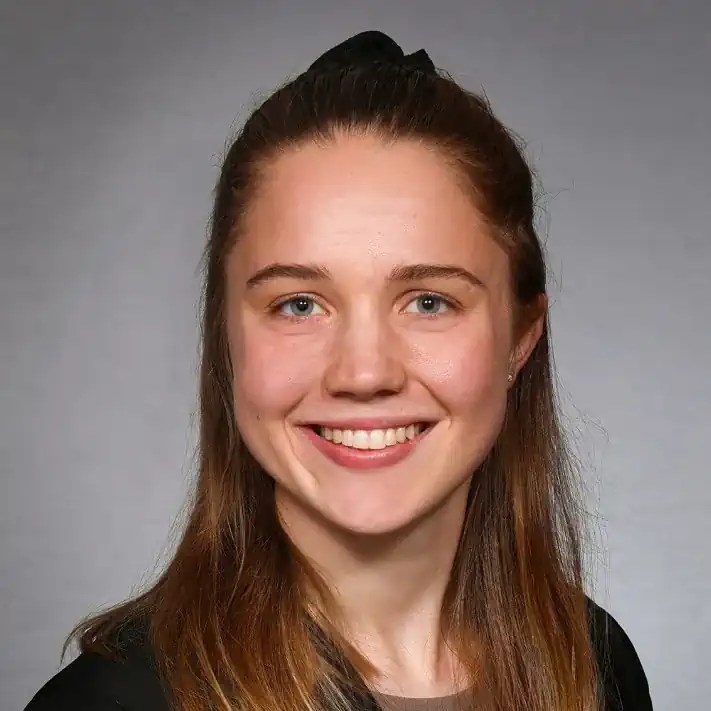
Amelia Hartley is a member of the VISTA team and dual degree student in Purdue University’s Public Health Masters/PhD Program. Learn more about her work, passion and many contributions to the VISTA team in this interview.
Q: What motivated you to pursue a role in public health research?
While I did not enter my undergraduate studies with a focus on public health, I quickly realized the critical role public health research plays in improving the lives of children and families in the community. Passionate about making change in this area based on lived experience as a survivor of family violence and an adoptee, I was excited to find the work of Dr. Schwab Reese and other public health researchers who were dedicated to producing translational research focused on improving the lives of at-risk children. Joining the lab and seeing the impact that my work through VISTA has already begun to make solidified my interest in pursuing a career in public health research.
“My work is motivated by the people I meet, the stories I hear, and the experiences I have had. I believe that all people deserve a safe home and a happy childhood.” – Amelia Williams
Q: How did you become involved with the VISTA research lab?
I joined VISTA in 2021 after finding Dr. Schwab Reese’s work in an online search query. Interested in pursuing a career in prevention and intervention of family violence, I reached out to Dr. Schwab Reese to learn more about her work and soon thereafter joined the lab as a research assistant.
Q: What specific area of public health research are you focused on?
While I have worked on a variety of projects at VISTA over the past three years, my primary focus has been research on effective child maltreatment prevention and intervention. For example, I played a key role in our lab’s research partnership with TalkLife, an online social support platform, which resulted in two published papers examining how young people use social media to make and respond to disclosures of family violence. In the upcoming year I am excited to have the opportunity to expand my expertise in child maltreatment prevention and intervention research to focus specifically on the family violence experiences of children with disabilities.
Q: What kind of tasks and responsibilities do you have?
My typical day in the lab varies significantly based on what projects I am working on and what stage each project is in. While I have played a role in a variety of projects from idea generation through publication, my favorite tasks tend to be in the analysis planning and execution phase of projects and include developing codebooks for qualitative content analysis and building programs for qualitative data analysis. Other common responsibilities I have include searching for and documenting existing literature to inform current projects, writing for publication, collaborating with other lab members to leverage each other’s respective expertise, and presenting novel research at conferences.
Q: Are there any particular public health issues or topics you hope to explore further?
I am excited to further explore the intersection of our work in child maltreatment with those issues faced by the disabled community. Outside of the lab, I have spent a lot of time working on disability rights and rare disease advocacy in the United States. This work has led me to think deeper about how the issues of child maltreatment and family violence that my projects at VISTA have focused on are experienced differently in families with disabled parents and/or children. Through my work in my dissertation and career, I hope to work further to understand how ableism impacts child protection in the United States and what can be done to protect disabled people within families while not compromising their rights.
Q: What do you find most rewarding about working in public health research?
For me, public health research, particularly that which leverages the translational research approach emphasized by the VISTA lab, is a very rewarding field because of the noticeable return on investment. Our work recognizes that the issues faced by many communities have a lasting impact that will be felt for years to come if not addressed. Thus, our projects focus on policy and program implementation that aim to improve common struggles in both the short- and long-term. While it can be easy to get caught up in some of the more frustrating administrative tasks universally required for high quality research, being able to witness the immediate impact on communities helps me remember that even though some tasks are mundane, the investment is worth it in the end.
Q: What keeps you motivated and passionate about your work?
My work is motivated by the people I meet, the stories I hear, and the experiences I have had. I believe that all people deserve a safe home and a happy childhood. Unfortunately, through my own personal experience and those shared with me by others, I know that many children are exposed to violence and instability within their family that has detrimental impacts on their well-being which lasts their whole lives. Knowing I can make a difference in the lives of at-risk children keeps me motivated and passionate about my work. While I may not be able to save all children from experiencing family violence, I am confident that my work through VISTA and beyond will make a difference that improves the life of at least one child, if not many more. Whoever that child may be, I know that their safety and happiness is well worth all the work I have dedicated to and will continue to dedicate to this research.
You can follow Ms. Hartley’s work on her LinkedIn page.
 lauraschwabreese.com
Leave a comment